VFC Group – Different by Design
January 19, 2026
As the Lightning Protection (LP) industry in the United States has grown, so has the number of companies offering lightning…


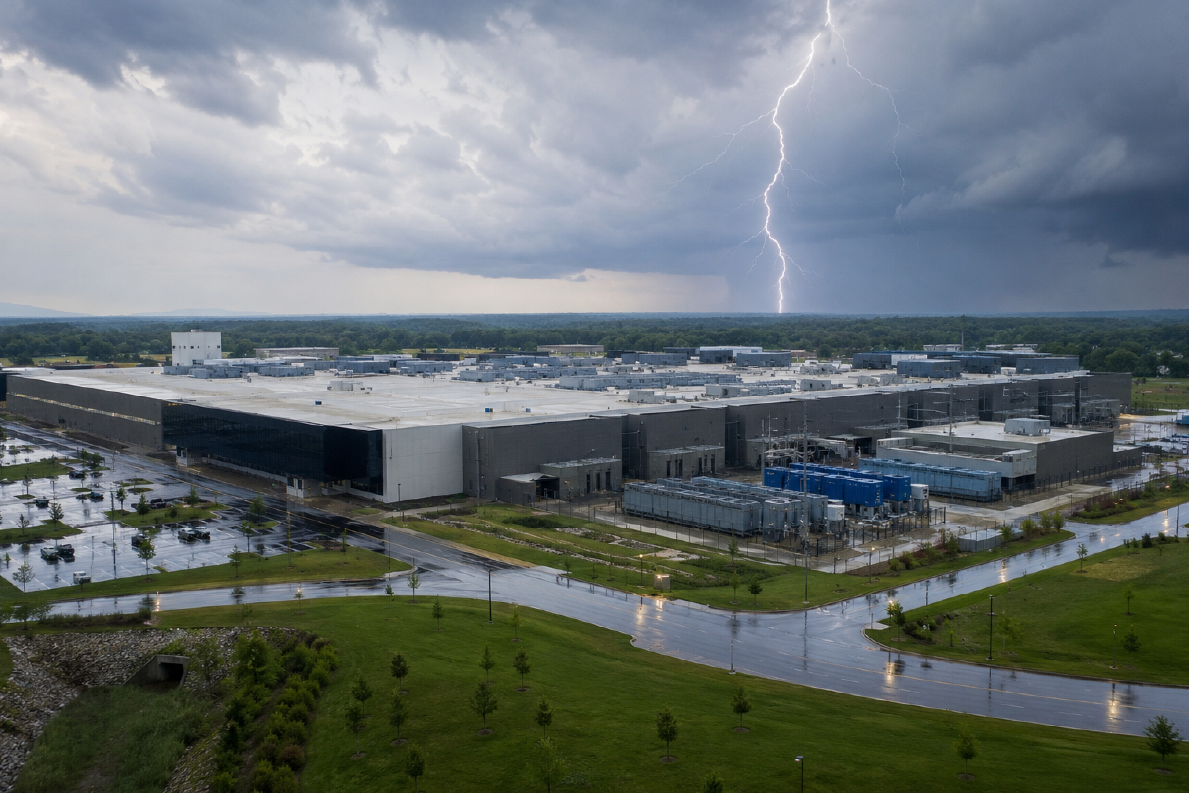
For a data center, the lightning protection question should extend beyond “Will this installation pass inspection?” Engineers should also ask, “Can we verify that it remains effective ten, twenty, or thirty years from now?” VFC and Lyncole’s approach is a lifecycle discipline: Assess, Design, Install, Monitor, Maintain.
Make resilience the design objective
NFPA 780 provides the foundation for lightning protection, including grounding, bonding, strike termination, and surge protection (NFPA 780, 2026 edition). For data centers, VFC recommends specifying that foundation together with explicit enhancements addressing long-term reliability and maintainability.
Our position is straightforward: provide lightning protection for every data center, regardless of geographic location. Do not make a favorable risk score the prerequisite for protecting critical operations. NFPA 780’s informational Annex L.1.1 identifies continuity of critical services as a reason to seriously consider protection regardless of a risk assessment’s outcome (NFPA 780). Site-specific assessment still informs the design and does not disappear simply because the decision to provide protection has been made.
Build the foundation below grade
VFC recommends the following enhanced grounding criteria for data centers. These are project requirements to specify deliberately, not universal NFPA 780 minimums:
NFPA 780 §4.12 addresses electrode arrangements, §4.12.4 addresses ground rings, and §4.13 requires interconnection of grounded systems; the lightning protection ground must not become an isolated grounding island (NFPA 780). Coordinate the ring with electrical, communications, structural, and other required grounding connections.
The 10-ohm target is an acceptance criterion, not proof of complete lightning performance. Annex E.1.1 explains that conventional resistance measurements operate at frequencies well below those of a lightning discharge and can be influenced by remote interconnected grounds (NFPA 780). The designer must define what is being measured and account for parallel paths. Use qualified personnel and controlled procedures for testing and any disconnection, maintaining required safety grounding.
Strengthen structural protection
VFC recommends Class II materials throughout the data center’s structural lightning protection system, even where building height would permit Class I. NFPA 780 §4.1.1 and its tables establish material classes and larger Class II main-conductor cross sections; §4.2 separately addresses corrosion resistance and material compatibility (NFPA 780). Larger conductors are not a substitute for proper corrosion control.
For zone-of-protection analysis, specify a 100-foot rolling-sphere radius, using the striking-distance criterion in §8.2.1 alongside the method in §4.7.3 (NFPA 780). Chapter 8 applies to structures housing explosive materials, so its use here is a voluntary design enhancement, not a claim that data centers fall under that occupancy (NFPA 780, §8.1).
Similarly, specify bonding of metallic masses within calculated sideflash distance using §§8.5.2–8.5.3, retaining that section’s stated small-mass exceptions (NFPA 780). Retain the applicable Chapter 4 air-terminal layout, conductor-routing, support, and downlead requirements, while adding accessible roof-level disconnect points and matching identifiers on downleads, test wells, and as-built drawings for repeatable testing (NFPA 780, §§4.5–4.11).
Specify continuous smart ground-resistance monitoring with documented baselines, alarm thresholds, and assigned response responsibilities. Add a smart lightning-event counter, installed according to its manufacturer’s instructions, to record event time and available current information.
Treat these instruments as maintenance tools, not automatic proof that every conductor, bond, or electrode is intact. Select monitoring arrangements that match the grounding topology, and investigate abnormal readings or recorded events through the established inspection and testing process.
Surge protection is equally integral: NFPA 780 §4.19 covers power, signal, data, and communications protection (NFPA 780). VFC recommends coordinated protection throughout the distribution system and at sensitive equipment, engineered around equipment withstand levels and manufacturer instructions. Detailed SPD selection and coordination deserve a separate article.
Verify performance throughout service life
Require independent UL or LPI-IP inspection to the specified NFPA 780 edition, with separate documented acceptance of project enhancements. UL can inspect to NFPA 780, so the issue is the inspection scope, not the Master Label name; a UL 96A-only certification should not substitute for verification of the full specification (UL Solutions). NFPA 780 §1.5.3 requires impartial certification where required by the authority having jurisdiction (AHJ) (NFPA 780).
At commissioning, document continuity, grounding acceptance results, monitoring baselines, and the designer’s test plan. Thereafter, VFC recommends annual visual inspections and comprehensive testing at least every three years, sooner where conditions warrant. Section 1.7 requires annual inspection or testing unless the AHJ determines another interval; informational Annex D recommends in-depth inspections every one to three years for critical systems and inspections after known strikes or alterations (NFPA 780).
Renew certification on the applicable program cycle: LPI-IP certificates expire after three years, while UL Master Label certificates generally expire after five, unless otherwise stated or invalidated earlier (LPI-175; UL service terms). Certification, testing, and continuous monitoring should reinforce one another, not replace one another.
The objective is not simply an approved system design and installation. It is a maintainable system with documented performance throughout its service life. Contact VFC Group for project-specific lightning resilience designs, design review, monitoring, and inspections.